Request for Information (RFI) on Advancing Privacy Enhancing Technologies by Joseph Wehbe
National governments need to contribute to grassroots AI ecosystem. Each stakeholder in an AI ecosystem adds to build a value network from the local government up to federal policy. An AI ecosystem is comprised of eight stakeholders that all have different goals. For these stakeholders to achieve their goals, they require government support.
The role of national governments specifically starts in providing recognition to AI degrees and education immediately at the graduate school level, but also in the k-12 curriculum. Imagine if government departments of education don’t recognize medical, legal, or teaching degrees? The education system wouldn’t function. But the paradox is that departments of education require to build internal expertise to be able to recognize such AI degrees.
The AI ecosystem and the approach to building the next generation of AI talent, can’t be compartmentalized. AI workshops, certifications, and bootcamps have no educational merit. They don’t build practitioner level skills.
DISCLAIMER: Please note that the RFI public responses received and posted do not represent the views or opinions of the U.S. Government. We bear no responsibility for the accuracy, legality, or content of the responses and external links included in this document.
Office of Science and Technology Policy (OSTP)
on behalf of the Fast Track Action Committee on Advancing Privacy-Preserving Data Sharing
and Analytics of the Subcommittee on Networking and Information Technology Research
and Development (NITRD) of the National Science and Technology Council,
the National Artificial Intelligence Initiative Office,
and the NITRD National Coordination Office
Re: Request for Information on Advancing Privacy-Enhancing Technologies
(Document Number: 2022-12432)
Submitted by:
Joseph Wehbe is an American artificial intelligence ecosystem builder. Led the #1 winning team of a Massachusetts Institute of Technology (MIT) Challenge (knowledge-economy) in 2020. He received an AI master’s degree recognized by the leading research institute in Canada in which Dr. Geoffrey Hinton (the Godfather of AI) is the Chief Scientific Advisor. Joseph is also an ambassador for Stanford Women in Data Science in Canada.
Dear Sir/Madam,
Effectively developing a national strategy on privacy-preserving data sharing and analytics, and associated policy initiatives requires:
1. Operationalizing the strategy at a Federal, State, & Local Government using a software / infrastructure layer.
2. Building a pipeline of talent & projects as a Government to Grassroots AI value network to execute on this strategy.
3. Redesigning the entry margin for verified stakeholders, marginalized and underrepresented groups along with the non-consumers to have a way to participate.
Context for my response:
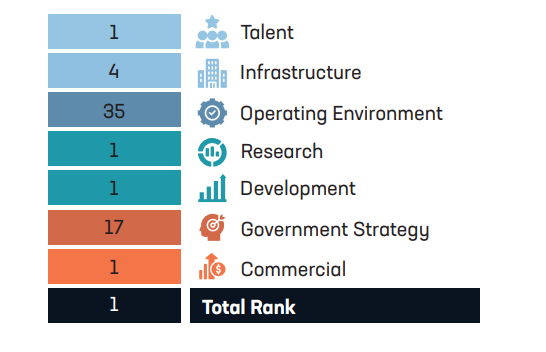
According to the AI Index Report 2022, the US ranks 1st globally in Talent, Research, Development, and Commercial. (see graphic below)
While we rank 35th in operating environment, and 17th in government strategy. Our low ranking in these 2 areas are the basis of all my feedback. This translates into the USA having the best talent, entrepreneurs, innovators, and companies in the world, but the strategies do not effectively impact the local government level. Why? Because the innovation and artificial intelligence ecosystems in the US are built around the greatest learning institutions in the world, who carry the responsibility. They don’t revolve around the people. In AI development, while technology and algorithms have been commoditized, skilled workers that are able to create solutions to AI problems are the most important factor. There is a demand for a whole generation of workers with capacities in artificial intelligence. This will be the generation of talent that will support national interest in aerospace, defense, education, housing, transportation, public safety, supply chain, manufacturing, and many other industries critical to the American homeland. We can improve the 35th and 17th running using a software and infrastructure layer.
USA
Global
Index
Ranking
https://www.tortoisemedia.com/ intelligence/global-ai/

lntelliigence | Global Al Index

United States
of America
My Responses to Question 9 & 10 combined below:
- [Response by JW] Existing barriers, not covered above, to PETs adoption:
Information about technical, sociotechnical, usability, and socioeconomic barriers that have inhibited wider adoption of PETs, such as a lack of public trust. This includes recommendations on how such barriers could be overcome. Responses that focus on increasing equity for underserved or marginalized groups are especially welcome. - [Response by JW] Other information that is relevant to the adoption of PETs:
Information that is relevant to the adoption of PETs that does not fit into any of the topics enumerated above.
Based on my proprietary frameworks, in building artificial intelligence ecosystems there are 8 stakeholders that effectively connect as a value network. While government policy and advocates will call to increase diversity of talent by lowering the barriers of participation for all regardless of organizational affiliation, this is a recipe for disaster.
If this happens, it means we are removing educational merit if we want security, and accountability. My frameworks redesign the entry marging / the entry barrier to Artificial intelligence (and other technologies) not lower the barrier. The existing barrier to PETs adoption can be solved by redesigning the entry barrier for each stakeholder.
In my experience as a World Economic Forum artificial intelligence and entrepreneurship expert, I believe there’s a demand for a whole generation of workers skilled in technology. These technologists must emerge from innovation ecosystems. There are systematic, structural and institutional barriers that many times and almost always limit opportunities that are also applicable to PETs. Once we identify the attributes of each innovation ecosystem, we can use artificial intelligence to identify the specific barriers affecting PETs.
We can’t generalize or compartmentalize the barriers. Successful innovation ecosystems that we know of in Boston, Silicon Valley, and Seattle all have educational merit. Why? Because they are anchored by the most successful entrepreneurs and ventures in the world.
Innovators from underrepresented backgrounds and underserved communities do not have a pathway to achieve their innovation goals. Capital is not the barrier in these ecosystems. It’s the lack of intellectual infrastructure in the region that’s the main barrier. Using advanced technology and artificial intelligence, we can identify the attributes of each community. Generalizing the results is doing a dis-service to the community. And relying on human knowledge alone does not do the work / results justice.
Using a software layer, the US Federal government must identify the stakeholders who are eligible to participate in the innovation ecosystem. Think of those “eligible” as the “total addressable market.” From this pool of eligible stakeholders, we identify those who have shown a willingness to become entrepreneurs, innovators, or technologists using various artificial intelligence methods that we can identify. To provide context, a Harvard Business School professor’s definition of entrepreneurship is “the pursuit of opportunity beyond resources controlled.” In this case, my definition of underrepresented, underserved, or marginalized is an individual or group who has knowledge and education of the said technology or innovation but lacks the intellectual infrastructure to realize their goals. The education component is critical because everything we do, must have educational merit. If our targets are truly innovators/technologists, these stakeholders must have educational merit. We are not expecting them to have all the knowledge, but should have access to the intellectual infrastructure. Using artificial intelligence, we can identify those most likely to succeed innovators/technologists and unlock their potential to succeed. Unfortunately, using human knowledge alone to realize this goal is difficult.
Entrepreneurs/technologists from marginalized groups and underserved communities all exist / live in communities with community colleges, technical schools, vocation schools, colleges, universities, and high schools. Using technology and a software layer, we can leverage these institutions to identify the specific barriers. But we must “redesign the entry barrier” so that these stakeholders (innovators or specific user type) understand “how” to achieve their goals, otherwise, they won’t have the willingness to share and engage. Again, we can’t “lower” the barrier to engage, because that won’t have educational merit, we must redesign the barrier.
I will reinforce again that capital is NOT the barrier for marginalized or underserved innovators to achieve their goals. If we throw capital at the problem, but the intellectual infrastructure does not exist, then we don’t achieve our goal. Let us use technology and artificial intelligence to solve this problem, redesign the entry barrier for stakeholders, and build a pipeline of
innovators so they are no more underrepresented, underserved, or marginalized. Our goal is to have upward mobility for each of these stakeholders so that they are no more identified as such.
Highlights of AI expertise I offer:
– The benefits of AI ecosystems are distributed unevenly across the US & don’t exist
in the heartland.
– Dismantle institutional, & systematic barriers that limit opportunities for stakeholders
in AI & bring educational merit to the AI workforce.
– Redesign entry margin for stakeholders so the US can build a pipeline of AI talent.
Your faithfully,
Joseph Wehbe
“AI Ecosystem Builder”
“The recipe is straightforward, let us invest in AI Education, AI Research & Development.”-JW